

 Construction has always been about momentum.
Schedules move quickly. Crews coordinate across tight spaces. Developers balance budgets, timelines, and long-term performance. General contractors manage dozens of moving parts at once. On multifamily, apartment, hotel, and large business projects, every decision matters because every system affects the building that comes next.
That is especially true for plumbing and HVAC.
These systems are no longer viewed as simple behind-the-wall necessities. They are central to comfort, efficiency, reliability, maintenance planning, and the long-term success of the building. Across the industry, advances in technology, coordination, prefabrication, and high-efficiency equipment are changing how mechanical contractors plan and deliver their work.
At UMC, Inc., we see those changes as an opportunity.
For more than 50 years, UMC has provided turnkey plumbing and HVAC solutions for large-scale new construction across the West. Our foundation is built on integrity, safety, quality, service, initiative, ownership, teamwork, and education. Those values matter even more as the industry evolves.
Because new tools are only valuable when they are backed by experienced people who know how to use them well.
HVAC Is Becoming More Intelligent
Today’s HVAC systems are being asked to do more than heat and cool a building.
They need to support comfort across many different spaces. They need to help manage energy use. They need to work with building automation systems. They need to be serviceable, reliable, and adaptable to the needs of owners, operators, residents, guests, and tenants.
The U.S. Department of Energy notes that heating and cooling account for about 35% of building energy consumption, making HVAC one of the most important areas for efficiency improvements in the built environment. That is a major reason the industry continues to invest in next-generation HVAC and water heating technologies.
For new construction, this means HVAC planning has become more strategic.
System selection, ductwork coordination, equipment placement, ventilation, controls, access, and commissioning all have to be considered early. When these decisions are coordinated well, the final building is better positioned for performance and long-term operation.
UMC’s HVAC teams understand that every large project has unique needs. A hotel does not operate like an apartment community. A multifamily development does not have the same usage patterns as a large business facility. Amenity spaces, common areas, corridors, mechanical rooms, and individual units all require thoughtful planning.
The goal is not just to install HVAC equipment.
The goal is to help create a building that feels comfortable, works efficiently, and supports the people who use it every day.
The Rise of Smarter Controls and Connected Systems
One of the biggest advances in the HVAC industry is the continued growth of smart controls and connected systems.
Modern HVAC controls can monitor and adjust temperature, airflow, humidity, and system performance with far greater precision than older approaches. Building automation and connected technologies can give operators better visibility into how a building is performing and where adjustments may be needed.
For large buildings, that visibility matters. It can help facility teams identify issues earlier, manage comfort more effectively, and make more informed decisions about energy use and maintenance.
But smart systems still require smart installation.
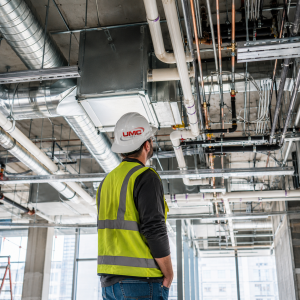
Controls, sensors, equipment, ductwork, and mechanical layouts all need to work together. The best technology cannot overcome poor coordination in the field. That is why UMC’s role as a mechanical partner is so important. We help make sure the work behind the walls, above ceilings, and inside mechanical spaces supports the future performance of the building.
In other words, the technology may be getting smarter, but the need for craftsmanship and coordination has not gone away.
It has become even more important.
Plumbing Is Moving Toward Better Coordination and Predictability
Plumbing systems in multifamily, apartment, hotel, and large business construction are complex.
A single project may include hundreds of kitchens, bathrooms, laundry areas, mechanical spaces, amenity areas, pool support systems, boilers, drains, vents, risers, and equipment connections. Every pipe has a purpose. Every route has to coordinate with structure, framing, HVAC, electrical, fire protection, and architectural requirements.
As the construction industry evolves, plumbing work is benefiting from advances in digital coordination, documentation, and prefabrication.
Building Information Modeling, often called BIM, continues to play a bigger role in complex construction. BIM helps project teams visualize systems before they are installed, identify conflicts earlier, and improve coordination between trades. When paired with prefabrication or modular assemblies, it can support more predictable field installation and reduce job-site disruption.
Industry conversations around mechanical and plumbing prefabrication continue to focus on scaling prefab workflows, BIM delivery, shop productivity, and production tracking.
For UMC, the value of these advances is practical.
Better coordination helps teams see challenges before they become field problems. Better documentation helps project leaders make informed decisions. Better planning helps crews work safely and efficiently. Better sequencing helps protect the schedule.
That is especially important on large multiunit projects, where small delays can multiply quickly across repeated layouts and multiple floors.
Prefabrication: Building More Before Arriving On Site
One of the most exciting shifts in mechanical construction is the continued growth of prefabrication.
Prefabrication allows certain assemblies or components to be built in a controlled environment before they are delivered to the job site. For mechanical contractors, that can mean better quality control, cleaner staging, improved productivity, and less congestion in active construction areas.
It can also help address one of the biggest realities in construction: job sites are busy.
When multiple trades are working in the same space, every hour and every square foot matters. Moving some work off site can help reduce field conflicts and support a more organized installation process.
Prefabrication is not a shortcut. It requires planning, coordination, measurement, communication, and trust between the field and the office. Done well, it reflects the same values that define UMC’s work: initiative, ownership, teamwork, and quality.
The future of construction is not only about working harder.
It is about working smarter.
Water Heating and Mechanical Rooms Are Getting More Attention
Another area of advancement is water heating.
In hotels, apartments, multifamily communities, and other large buildings, hot water is not a minor convenience. It is essential to daily operations. Residents, guests, tenants, amenity spaces, kitchens, laundry rooms, and maintenance teams all depend on reliable water heating systems.
Across the industry, there is growing attention on high-efficiency equipment, improved controls, better system design, and electrification options for water heating and HVAC. The Department of Energy has highlighted research into next-generation HVAC, refrigeration, and water heating technologies as part of the broader effort to improve building performance.
For project teams, this makes early planning even more valuable.
Mechanical rooms have to be designed for today’s equipment and tomorrow’s maintenance needs. Access matters. Clearances matter. Piping layout matters. Venting, drainage, controls, and sequencing all matter.
UMC understands that mechanical rooms are not just back-of-house spaces. They are critical operating centers for the building.
When they are planned well, the building benefits for years.
Technology Supports the Team, but People Drive the Outcome
New technology can improve construction, but technology alone does not build a project.
People do.
It takes experienced foremen, trained crews, project managers, coordinators, estimators, vendors, general contractors, developers, engineers, and inspectors working toward the same goal. It takes communication. It takes accountability. It takes a team willing to identify constraints early and solve the right problems at the right time.
That is where UMC’s experience matters.
With more than five decades in the industry, UMC has seen construction methods change, markets grow, technologies improve, and project expectations rise. Through it all, the fundamentals remain the same: deliver quality service in a timely manner, communicate honestly, work safely, and take ownership of the result.
Our team continues to embrace better tools, better documentation, digital forms, tailored reporting, and improved workflows because they help us serve customers more effectively. But the heart of the work is still craftsmanship, collaboration, and pride in a job well done.
The Future Belongs to Better Partners
As the industry advances, the role of the mechanical contractor is becoming more important—not less.
Plumbing and HVAC systems are deeply connected to the long-term success of a building. They influence comfort, efficiency, reliability, maintenance, and the everyday experience of the people inside. That means general contractors and developers need partners who understand both the technical details and the bigger picture.
UMC is built for that role.
We deliver turnkey plumbing and HVAC solutions for multifamily developments, apartments, hotels, and other large new construction projects across Utah, Colorado, Idaho, and the West. We bring experience, bonding strength, field expertise, coordination, and a commitment to doing the work right.
Industry advances will continue. Equipment will become smarter. Coordination tools will become more precise. Building systems will become more connected.
But the best projects will still depend on trusted partners who know how to plan, communicate, and execute.
That is where UMC leads.
Ready to bring an experienced plumbing and HVAC partner onto your next large-scale new construction project? Visit umc.us or contact UMC, Inc. to start the conversation.